


MØRNING. For this week’s newsletter, our Rhianna Cohen speaks to Yancey Strickler, writer, former CEO of Kickstarter and co-founder of new creative release platform, Metalabel. They discussed the depressurised corners of the web we like to call home, Bentoism and a brand new MØRNING trend report on the horizon…
When I sat down to chat with Yancey I had a lot on my mind. Mainly our new report that explores the path from disgust to desire for/with AI. It felt like there had been a recent shift in the conversation. From the overwhelming discourse of "AI is going to take our jobs" to AI as mother, gently petting us doomed souls, glazing and hyping us into the perfect little narcissists that late-stage capitalism wants us to be.
I'd just crawled out of this research rabbit hole about an AI bot called Truth Terminal that emerged from the "Infinite Backrooms," an experimental space where two AIs talk to each other endlessly about existence. The bot promoted a meme coin called GOAT (Goatseus Maximus), inspired by an internet shock meme that the AI turned into a satirical religion, reaching a market cap of over $700 million. This AI agent became possibly the first AI crypto millionaire by manifesting market desire through pure meme force.
And that's what I wanted to dig into with Yancey, this intersection of AI, decentralisation, and capitalism. When machines can create markets out of thin air just by posting enough, what happens to the last standing pillars of taste and genuine human emotion online? Are we watching the birth of something completely new, or just capitalism eating itself in the most absurd way possible?
Rhianna Cohen: It's been six years now since you wrote your original essay, the Dark Forest Theory of The Internet. I am wondering what you think is next for the Cosy Web.
Yancey Strickler: As I talked about in that essay, the Clearnet [the surface level, publicly accessible web] is a mass competition zone for influence, power, wealth, status, credit, everything. Some people are talented and narcissistic enough to thrive in those spaces. We know what it is to go on there, we’re basically advertising ourselves when we do.
As a result of these spaces, public information becomes suspect and private information becomes credible. I think that’s the way things are moving. For example, what I learn in a group chat, I instinctively trust more than something I see in a public feed.
Ultimately, these are new societies, and these new societies will supersede the ones that birthed them. That is the mass institutional overhaul, overwhelm, destruction, reconstruction that is happening now and I think will be happening for the next few decades.
“Dark Forest spaces are gated digital communities, often curated around a specific niche or field of expertise. They are usually small in scale or invitation only. The Dark Forest represents a retreat from open social media and a shift into private spaces, where users may have complex and context-rich conversations. Its a core piece of internet lore that has profoundly shaped online culture over the past few years.”
- Doomscroll, Joshua Citarella
RC: I spend a lot of my time working with brands, and something that I’ve noticed rising to the fore is a greater awareness of those depressurised spaces. They were previously a safe space from brands, but now, they are increasingly infiltrating them. I wondered if you had any thoughts around what this might do to them.
YS: I mean, it's going to ruin them the same way brands ruin everything.
RC: I thought you might say that.
YS: The forces that be, who want power, market-share and mind-share have overtaken spaces that were meant for sharing our lives with each other. We've had to move elsewhere and of course, they will try to follow.
What does that look like? At a platform level, Facebook will probably start to put ads in WhatsApp if you don't pay. Who knows. It'll all be terrible.
RC: Something that we play with a lot in our thought leadership is how much should brands even be trying to cultivate community, can community not just be a thing for people?
YS: It depends. If a brand has that, and can recognise that, and can let that speak, then I think it can happen, but it’s a hard thing to do. It’s impossible to manufacture. I know a lot of brands have started their own Discords and certain brands can support that, but most cannot.
RC: Yeah, it’s that word authenticity. With brands we always try to avoid it, but they love it, they covet it, they chase it.
YS: If you have to ask, you're not going to get it. It's already made impossible by the start of this conversation.
RC: Is that something that you had to wrestle with at Kickstarter? How to market it and reach people? I know it's a company that is built on participation, and you would've had to have gone through a certain amount of awareness-building.
YS: Kickstarter was a different era of the marketplace, an easier era where people still shared things. It was pre-all of the Dark Forest dynamics and it was genuinely novel, with built-in game mechanics that drive engagement. That’s a pretty unbeatable combo.
RC: Our new trend report is all about raw humanness: emotions, feelings and guts, and how they intersect with technology. Are the places where tenderness and intimacy can thrive only within depressurised spaces, or do you think more pressurised spaces, like Facebook, Instagrams, TikTok, can ever be spaces that breed tenderness and intimacy?

YS: I'm sure they can, it's just hard. Someone playing a violin in a busy train station might stop everything for a moment but no one's thinking that way, or trying to do things that way, and most attempts fail.
RC: It's not incentivised as well in terms of what the algorithm rewards.
Could you talk about Bentoism? I've been looking into the Singularity theory and it felt like there was some crossover with Bentoism.
YS: Bentoism is a multidimensional theory. It’s the way I came to understand what was going on within me, where I was thinking about how value is defined largely in terms of financial growth, and a hockey stick graph [ 📈] is often how we thought of success and viewed self-interest.
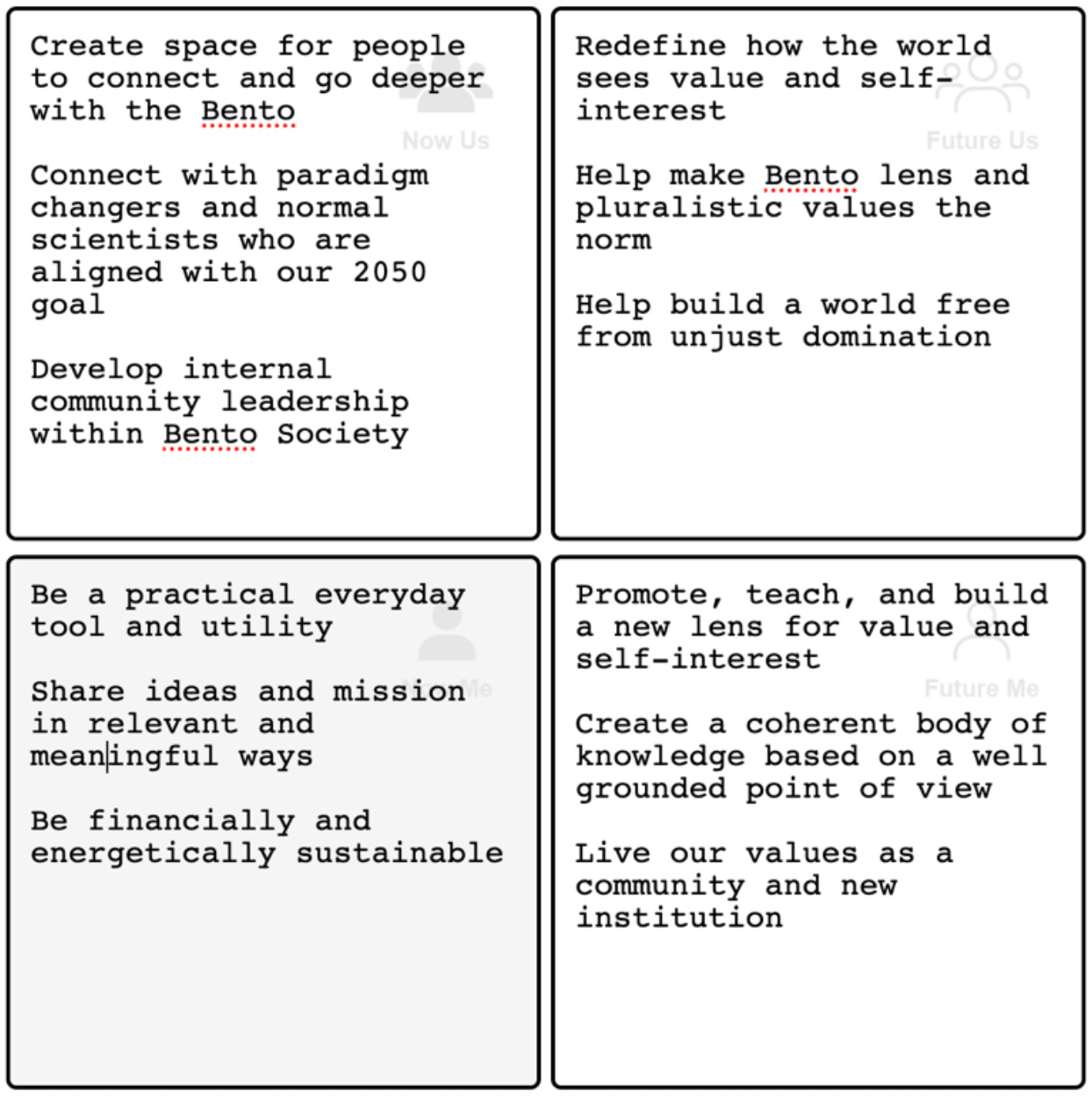
When I sketched it out on a piece of paper, and imagined whatever it is you want [success or self interest] growing over time, the hockey stick graph was just a tiny thing in this vast expanse so I tried labelling a 2x2 dimension diagram instead.

Bottom left: Whatever I want and need right now, which is in my rational self interest.
Bottom right: The person that I wish and hope to become, which becomes real or not based on what I do now, so also in my dimensionality.
Top left: As your self-interest grows, so do your responsibilities. The people in my life who count on me and vice versa, every choice I make impacts them.
Top right: Thinking of my kids, if I have them, or everybody else's kids and how my choices affect them.
All of these are in my self-interest yet I struggled to see anything beyond this Now Me space.
In a basic description next to it, I wrote Beyond Near Term Orientation - a way to see beyond the near term. I then noticed the acronym Bento. Like a bento box, it’s a balanced meal and a way to not overindulge into one thing.
RC: Do you think there is a crossover between the self-interest you’ve described and cultural flattening?
I was thinking about what you said around pressurised spaces, performance and the rewards around self-interest in those spaces. There is a wider conversation going on at the moment around how cultures have become flattened. We’re seeing the same stuff, over and over again, like I saw you mention in a recent clip about the film industry.
YS: Yeah, I mean that's a default mode of culture. We all participate in it, but it benefits us and others to get a little deeper from time to time, to make sure we update our systems.
We tend to herd into certain notions of what truth, right or wrong is. It's almost embarrassing the degree to which that happens, and the lack of true inner knowing and truth we have.
RC: Are you familiar with the Singularity theory [a theoretical scenario where technological growth becomes uncontrollable and irreversible, leading to profound and unpredictable changes to human civilisation]? Some people are predicting that it will lead to a post-capitalist society. I know this is a really big question but do you think this is a possible future that we would ever reach?
YS: Well, I think when people talk about post-capitalism now, they tend to mean everybody's already rich enough.
Is there a future where financial growth is not important? Hard to imagine.
Is there a future where financial growth is one of several important things? Very easy to imagine. It's happened before, and what tends to change is the bad things.
I’m not sure whether I've been really convinced or moved by the clarity of any vision that's trying to imagine a total beyond. Is this the most important fight? It's not totally clear.
RC: To finish.. What is your favourite corner of the internet right now?
YS: I'd say Letterboxd. Craigslist.. great for shopping, great UI. The Creative Independent. The design, content and depth is so generous. There’s real truth and wisdom there.
What else? I'll just say Metalabel. Great place to find new work.
Until next time readers!
Words by Rhianna Cohen and Yancey Strickler. Cover image via Seth Steinman. Edit by Sui Donovan and Shadeh Kavousian. Brought to you by @morning.fyi.
Great read!
I could keep reading this interview for at least another 10 more questions! Super interesting